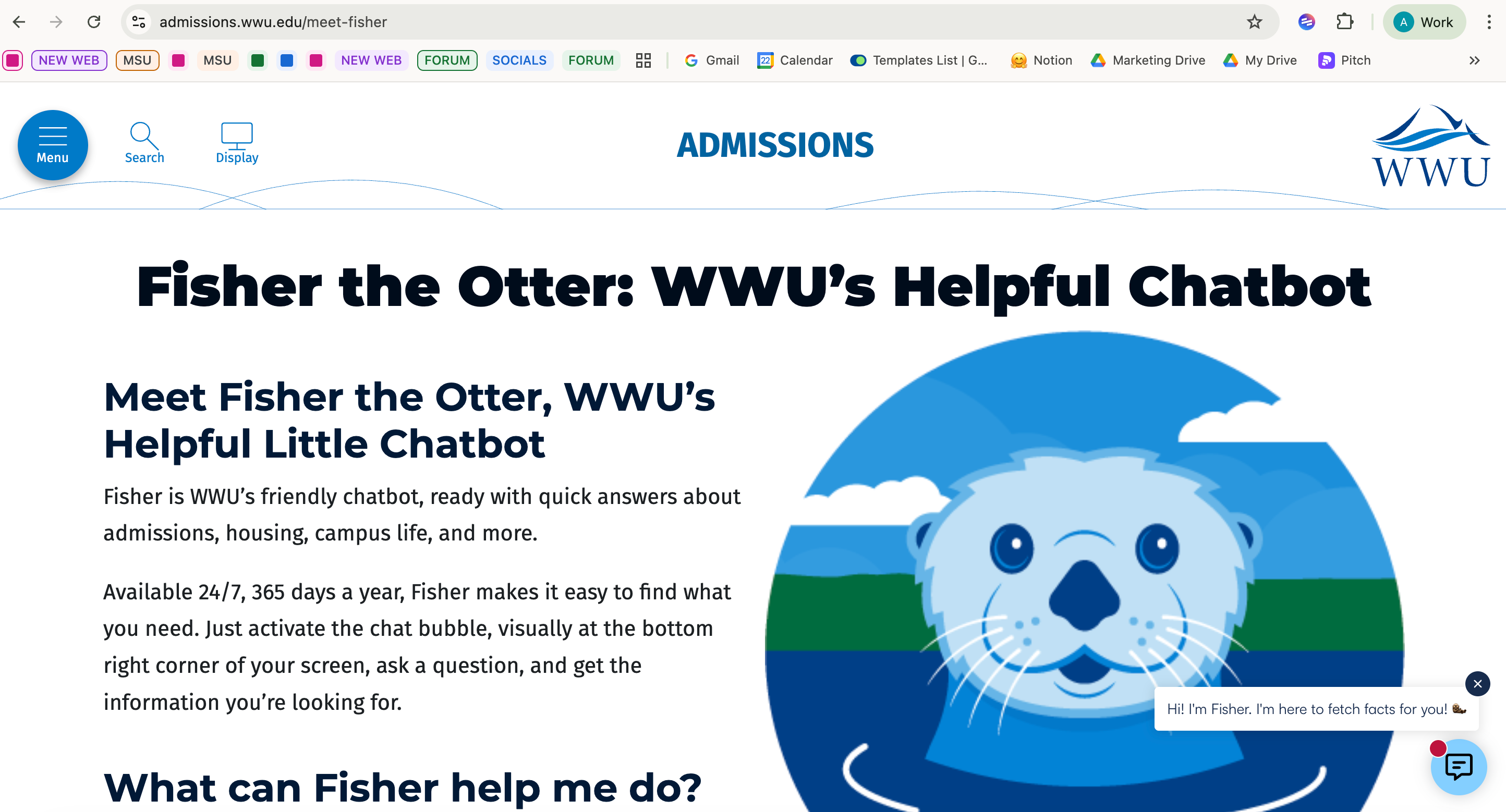
It’s always great to see our partners bring Gecko tools to life in creative ways. Western Washington University (WWU) recently did just that with their chatbot, Fisher the Otter.
Named after Charles H. Fisher, WWU’s fourth president, and echoing the iconic Fisher Fountain on campus, Fisher is more than a digital assistant, it’s a recognisable part of the university community. By giving their chatbot a name, a backstory and a dedicated home on their website, WWU has shown how personalisation can turn a piece of technology into something students actually want to use.
Spotlight: Fisher the Otter
WWU’s Fisher chatbot supports students, families, and visitors with answers about:
- Admissions
- Housing and campus life
- Academic programs
- Financial aid and scholarships
- University policies and more
Fisher is available 24/7, 365 days a year, through a chat bubble on WWU’s Admissions website. Students get instant answers whenever they need them, no waiting for office hours required. Behind the scenes, Fisher “fishes” through WWU’s official resources to surface relevant information. And when a question gets too complex, the chatbot seamlessly redirects the user to relevant contact information to connect with a staff member.
It’s an elegant mix of automation and human support, exactly the kind of balance students need.
What’s especially interesting is that Fisher isn’t just helping prospective students. Staff and faculty across WWU are using it too, turning it into a campus-wide resource rather than just an admissions tool.
Behind the Scenes: Why It Works
What makes WWU’s approach stand out isn’t just the technology, but the thoughtful way it’s presented:
- Institutional identity: Naming the chatbot after a former president and a familiar campus landmark makes Fisher part of the university culture.
- Friendly, student-first language: Fisher is introduced in approachable, helpful terms. No tech jargon, just clear support.
- Clear expectations: Fisher provides quick answers and connects to staff when needed, building trust through transparency.
- Strategic placement: Fisher is featured prominently on WWU’s admissions pages, where students need it most.
- Data-driven approach: With Slate integration, WWU can measure Fisher’s impact and optimise future engagement.
Tips to Maximise Your Chatbot’s Impact
Inspired by WWU’s example? Here are some best practices to follow:
- Brand it: Give your chatbot a name and personality that reflects your institution.
- Create a dedicated page: WWU built admissions.wwu.edu/meet-fisher as Fisher’s home – a hub for promotion and discovery.
- Promote it widely: Add the chatbot link to email signatures, out-of-office replies, and marketing campaigns.
- Feature it on key pages: Admissions, recruitment, housing, and financial aid are ideal high-traffic locations.
- Use your own voice: Keep the tone conversational, friendly, and student-focused, just like WWU did.
- Track the data: Use tools like Slate to understand performance and drive improvements.
Why This Matters
A well-branded, visible, and approachable chatbot like Fisher demonstrates that your institution is:
- Accessible: Help is always available, whenever students need it.
- Innovative: Technology is used to improve the student journey, not complicate it.
- Student-centred: Support tools are built with clarity and care in mind.
For staff, that means fewer repetitive questions and more time for meaningful interactions. And when faculty and staff begin using your chatbot too, you know you’ve built something valuable.
Wrapping Up
Western Washington University’s Fisher the Otter is a fantastic example of how to transform a chatbot into a trusted part of campus life. With branding, visibility and student-first design, WWU proves that even simple tools can make a big impact.
Want to see how WWU did it? Visit Fisher’s dedicated page for inspiration. Then think about how to highlight your own chatbot: brand it, promote it and let it shine.